- Chinese consumers have long trusted the informal word of mouth within their social network more than any other means of communication.
- Over the last decade, the digital revolution has massively boosted the scale and speed of this social exchange of information and opinion. It is like Chinese whispers on steroids.
- Without massive media spend brands cannot grow, and without growth they cannot fund the media spend.
- Brand Advocacy can be unleashed for even mundane and low involvement products.
China is the most exciting growth opportunity in the world for companies and brands. However consumer attitudes and the media landscape present unique challenges. In this huge market, which can be a minefield to the uninitiated, a more authentic approach to Word of Mouth marketing using Advocates can be a game changer, delivering growth at a fraction of traditional media spend.
Word of mouth (WOM) recommendations of friends and family (F&F) have been consistently rated as the number one driver of purchase across countries. According to Nielsen’s Global Trust in Advertising study, 92% of people trust WOM recommendations from friends and family, while the same figure for TV is almost half at 47% and for online video it is 36%.
CHINESE CONSUMERS TRUST WOM EVEN MORE
WOM of Friends and Family is far more powerful in China and other emerging markets, compared to developed markets. A McKinsey study on mobile phones purchase showed that WOM was the leading factor at all stages of the consumer decision journey in developing markets, while in mature markets it was no. 3 (refer figure below).
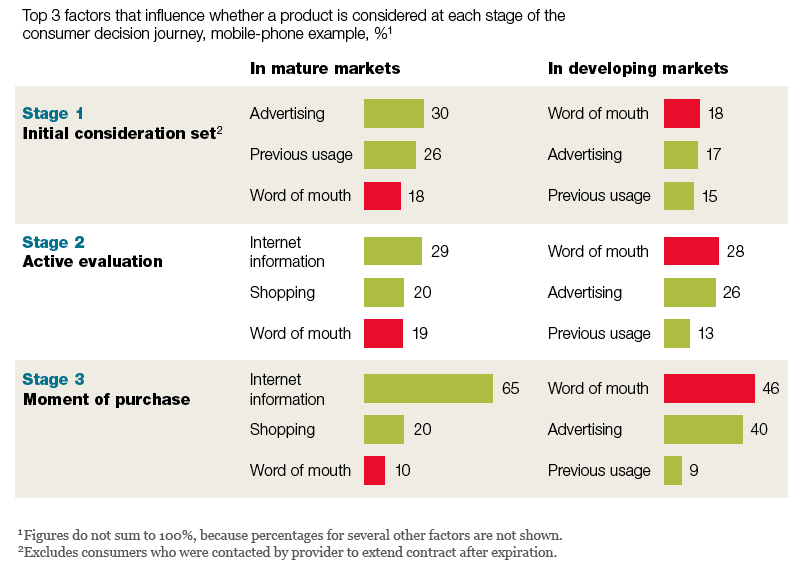
Source: “A new way to Measure Word of Mouth Marketing”, McKinsey Quarterly, April
In another McKinsey study, 68% of Chinese consumers said they would consider F&F recommendations when choosing a moisturizer compared with just 38% of respondents in the US and UK.
There are 3 key reasons why WOM is more powerful in China, compared to other markets.
- History of information control by government: Most people in China under the age of 70 today, did not see any commercial advertising until the early 1980s. Even by the end of that decade, there was only one TV channel and very few magazines and newspapers. Even when more channels became available in the 90s, the content was controlled. Censorship of programming continues even now. Thus, Chinese consumers have long trusted the informal word of mouth within their social network more than any other means of communication. Over the last decade, the digital revolution has massively boosted the scale and speed of this social exchange of information and opinion. It is like Chinese whispers on steroids.
- Product proliferation, contamination and counterfeiting: Chinese consumers are faced with a huge amount of new products, some of which are in categories they have never tried before. Mouthwash for example is used by less than 10% of Chinese households. Additionally, counterfeiting and sub-standard manufacturing are not uncommon. Thus knowing that somebody trusted has had a positive experience with a new product is a huge reassurance.
- A Culture of fitting in: “A nail that sticks out gets hammered in” might be a Japanese proverb but it applies equally in China. In general, people find comfort and security in ‘group think’ and following (as opposed to leading). Individualism is not as prized as in the West. Taking cues from what others around you are consuming is the norm.
MASSIVE PAID MEDIA INFLATION MAKES EARNED WOM EVEN MORE CRITICAL FOR BRAND OWNERS
In a market like China, where the challenge facing multinational companies (MNC) is habit change and habit creation, marketers need a medium which has high reach, high depth and is also trusted. Historically TV advertising has played that role in most markets. However brands in China have faced double-digit annual inflation in TV media costs for the last 10 years. Even MNCs with deep pockets cannot afford to support their brands with regular TV support beyond the Top 20-25 cities (which account for only 20% of the population). For example, Johnson & Johnson’s leading skincare brand Neutrogena is supported with TV advertising in only the Top 6 cities. To stand-out and take share from well entrenched players like P&G’s Olay and L’Oreal, it needs to cut through with heavy media weights. However even maintaining SOV in the current 6 cities is challenging, leave alone extending TV support to new cities. To maintain media weights, companies have cut copy length. China is now one of the few markets in the world where the majority of Consumer Packaged Goods (CPG) TV media spend is on 15sec ads and not the traditional 30sec. In short, brands are in a catch-22 situation. Without massive media spend they cannot grow, and without growth they cannot fund the media spend. Marketers are thus increasingly looking at activities, which can generate “earned” media or put simply create buzz.
MOST WOM MARKETING IN CHINA IS CURRENTLY TACTICAL AND LOW ROI
Marketers in China are well aware of the massive influence of WOM in their categories. However most WOM marketing activity currently in China reflects the old broadcast model mentality, even though it is mainly conducted online.
Brand managers do not want to let go of control. They want consumers to do WOM for their brands but want them to include the key benefit/big idea in the conversation. They forget that the message a consumer hears is not always the same as the message they share. After all, a consumer narrating in his/her own words how the product enhanced their life or solved a problem is much more compelling and relevant to their friends than a clever tagline and demo. A mindset change is required to bring marketing in line with the changed power equations between brands and consumers.
Focus needs to be on conversions not impressions, recommending not spreading, brand utility not brand content, active advocates not passive followers, generating reviews not views, building a sustained community and not doing one-off campaigns.
NURTURING A COMMUNITY OF BRAND ADVOCATES IS HIGH ROI
Every brand has advocates, who like the product enough to recommend it. Advocates do not need to be paid to talk about the brands they like, as it is human nature to share your positive experiences with other people. Connecting with these Advocates, and engaging with them regularly to seek their opinion or share value-added information further cements their bond with the Brand. The mere act of a brand reaching out makes them feel valued and respected. They become even more likely to recommend your brand within their social circle. Such authentic advocacy may not be creatively sexy and win awards at Cannes, but it delivers what ultimately counts- more people buying your brand.
The Boston Consulting group in its “Harnessing the power of Advocacy Marketing” said, “Advocacy is a gift that keeps on giving in at least three ways. First, there’s the snowballing effect of recommendations. Whereas advertising can drive consumers down the “purchase pathway”—from category interest to brand awareness, brand consideration, and finally brand purchase—word-of-mouth advocacy turns that one-way street into a roundabout, as customers who purchase the product encourage new customers to enter the virtuous circle. In other words, advocates beget advocates – and, over time, the cost to acquire new customers plummets.
The good news is that, Brand Advocacy can be unleashed for even mundane and low involvement products. The Fiskateers community created by Brains on Fire for FISKARS, the scissor brand is a good example of this.
Even in China, progressive marketers like Reckitt Benckiser are embracing Advocates led marketing and enjoying high ROI. On Dettol, one of its global power brands, Reckitt Benckiser China has built a community of over 30,000 moms over a period of 12 months. These moms are spreading the word about Dettol offline and online. Over 25,000 authentic consumer reviews, comments and photos now exist online about Dettol, a low involvement antiseptic liquid. This authentic user content optimized for search engines is influencing and converting other consumers 24/7. Besides advocating Dettol within their social circle, these consumers have also helped the brand team create and validate new messaging and product ideas, in half the time and cost of the traditional approach. They are now pretty much like an extended marketing team on Dettol. See the case study below.
More importantly, the high ROI of the Dettol Advocates community has been conclusively proven by TNS brand tracking. Over 3 waves of tracking, the geographies with the Advocates community far outperformed other geographies on all brand health indicators. In Advocate geographies, recall of Dettol’s key message reached almost 50%, with no TV advertising. In the past, to achieve this level of message recall Dettol had spent 10-12 times more.
WOM recommendations are a powerful purchase driver, more so in emerging markets with high trust deficit like China. To efficiently and effectively generate such authentic recommendations, brands need to build a community of advocates and engage with them in a sustained and authentic manner. This requires a mindset change and new skills. It is high time we said goodbye to the 1950s model of brand marketing pioneered by P&G, which relies on brand content around a big idea. Community, Collaboration and Conversation need to be the focus from now on. Authentic Advocacy that drives growth at a fraction of traditional media cost will be the prized outcome, of this new focus.
This article by Asit Gupta was first published in the B.O.M.B (Business Owners Marketing Brief) and the Smart Bomb on the Onnero platform in partnership with the 8020 Center in January 2013. Asit Gupta is co-founder of Advocacy, Asia’s leading WOM marketing company, head quartered in Shanghai with operations in China and India. He is one of the few marketers who have worked in 3 out of 4 BRIC countries, having worked with Procter & Gamble, British American Tobacco and DDB advertising across India, Russia, UK and China.