The Athletes Laughed Out Loud When He Made His First Jump… A Week Later The Laughter Stopped (And His Competitors Would Spend The Rest Of Their Lives Trying To Copy Him)
Have you ever wondered what creates a winner?
As the young American, Dick Fosbury lined up to take his first high jump in the heats of the 1968 Olympic Games in Mexico he had reason to feel nervous. He was about to use a technique for jumping that had never before been used at the Olympics.
Yet despite his nerves, Fosbury also had reason to feel confident, since the history of high jump was written by athletes who were prepared to let go of the old way of doing things and to try something new.
As Fosbury began his run towards the bar, he was about to rewrite history and join a long line of athletes who had propelled the sport forward, or more accurately upward.
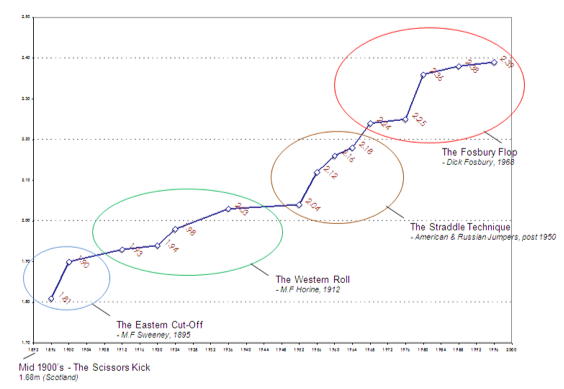
The original winners of the event used a technique known as the eastern cut-off in which they scissored kicked their legs over the bar, but leaned back until their bodies were almost horizontal to the ground.
This technique first pioneered in 1894 led to gold for American Michael Sweeney, but also to a bumpy landing.
The Western Roll
It was in 1912 that George Horine made the next breakthrough when he introduced the Western Roll. With this technique, Horine took off with his inside leg but then thrust his outside leg over the bar in mid-air.
It looked peculiar to crowds, but it worked.
Horine broke the world record and the Western Roll became the standard technique through till the 1936 games in Berlin.
Then a new form emerged known as the Straddle jump. This technique would come to dominate high jumping for the next four decades with the king of this technique being the Russian athlete, Valeriy Brumel.
The Wrong Direction
As the American coaches flocked to the Soviet Union to learn from Brumel and his trainers, the greatest innovation of all was occurring in their own backyard in the form of a young Oregon State University jumper named Dick Fosbury.
When Fosbury soared over the bar on his first attempt at the 1968 Olympics the crowd reacted in shock to something most had never seen before.
Rather than rolling over the bar, belly down, Fosbury led with his head and ‘flopped’ over the bar landing on his back.
Laughter At The “World’s Laziest High Jumper”
After a short stunned silence the laughter began. One newspaper labelled him the “World’s Laziest High Jumper” and another said he looked like a “fish flopping in a boat.”
The laughter didn’t last long. By the end of the week, Fosbury had not only won the gold but also set a new Olympic record. The athletes, who started the week laughing, would spend the rest of their life trying to copy him.
The history of high jump is a story of how big breakthroughs in performance happen.
Someone creates a better way, others imitate it, refine it, and improve it. But at some point along the way, the improvements level off, the return on effort diminishes and results plateau.
Then someone thinks differently. They momentarily let go of the old way and try something new.
At first the new approach may look and feel strange, but if the new form is good, with some practice, the new approach leads to breakthrough levels of performance.
Of course, I am not talking about the development of a jumper any more; I am talking directly about the development of a new system to sell your service.
Business Owners Are Stuck
They are stuck because a number of years ago they worked out series of actions required selling their product and now those actions no longer work.
At first they tried ads in the paper and yellow pages, maybe telemarketing and made the phone ring.
But lately no matter how much money gets spent it is becoming harder to get the phone to ring.
The Yellow pages and national papers have died for advertisers. It is still highly debatable whether digitak marketing and social media is really the media to reach the audience (it can be a huge waste of time and effort and it’s getting more and more expensive). Radio is hard to measure and TV simply too expensive for most.
The business owner often thinks they just need to polish what they’ve got, but what they really need is to let it go.
Too many leaders are still trying to perfect an old fashioned Western Roll when what they should be doing is experimenting with the Fosbury Flop.
Is AI the new “Fosbury Flop”?
It’s way too early to tell. Maybe in a decade or so?
Entire industries are following people who are following people, who are following people who are lost.
When you try to sell yourself by following everyone else you will soon become invisible.
I cannot tell you what the Fosbury Flop is for your industry but it exists. Your job is to keep your mind open and find it first. The good thing is that hardly anyone else is even looking.
This article by Richard Petrie first appeared in Onnero’s Modern Business Magazine in 2013. Richard Petrie is the founder of Speed Marketing. He is also a former test cricketer from New Zealand and co-founder of cricket website crickinfo.